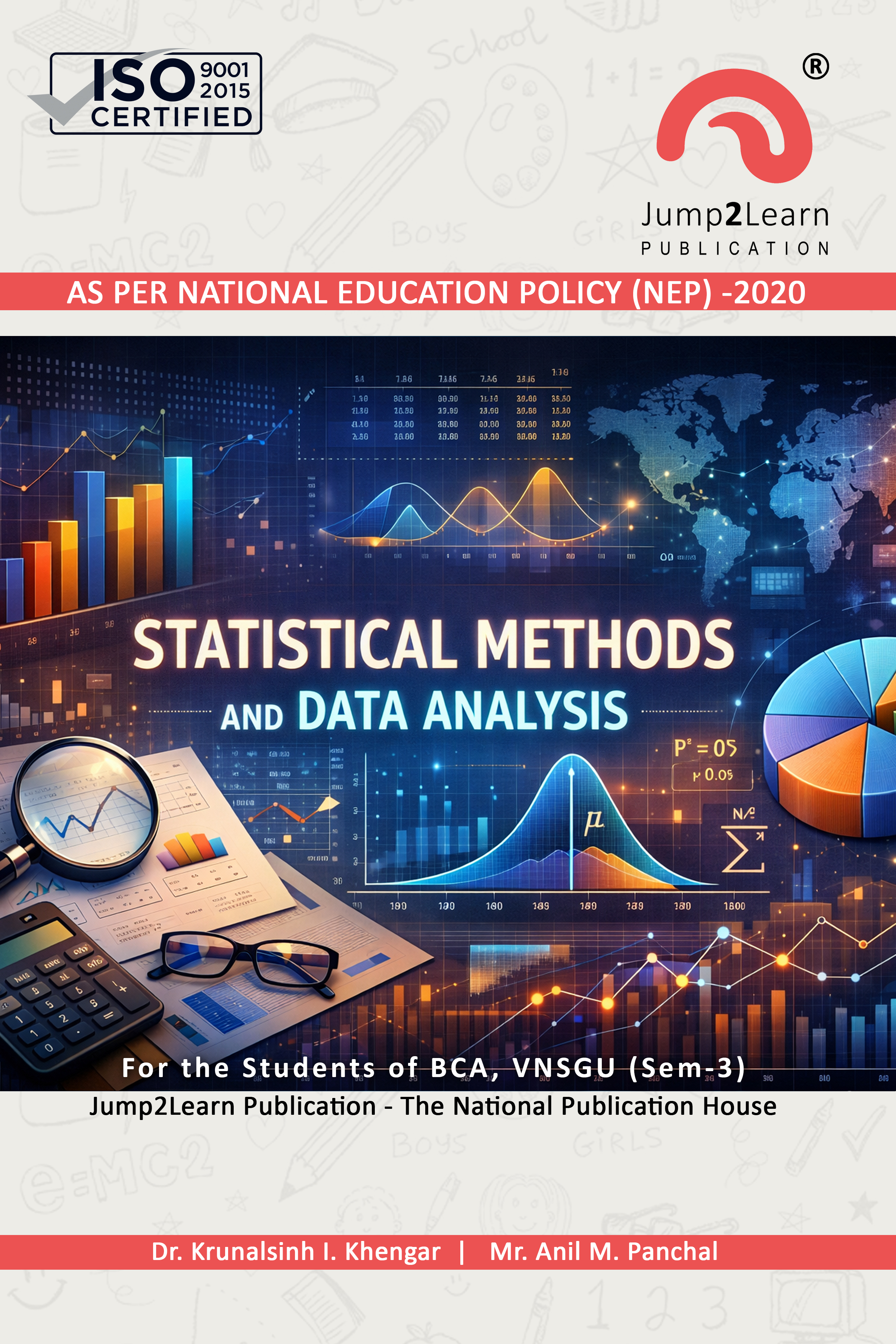
STATISTICAL METHODS AND DATA ANALYSIS
₹260 ₹510
Authors :
Dr. Krunalsinh I. Khegar
Dr. Krunalsinh I. Khengar (M.com, M.Phil, Ph.D) is currently working as an Assistant Professor of Statistics in Navyug Commerce College- Surat. He has more than 13 years of total experience in academics. He has to him credit the publication of several papers in reputed journals and has even presented papers at national and international conferences.
Mr. Anil M. Panchal
He is currently working as an Assistant Professor at The Mandvi Education Society, Institute of computer studies (MCA department). He has completed his Master of Science in Applied Statistics from Department of Statistics, Veer Narmad South Gujarat University, Surat. Currently, he is pursuing his Ph.D. from Veer Narmad South Gujarat University. He is having more than 12 years of teaching experience. He has achieved a Certificate in R Programming from Johns Hopkins University in 2019. He has also achieved a Certificate in Introduction to Probability and Data from Duke University in 2019. He is actively involved in various Social and Youth Activities.
He is currently working as an Assistant Professor at The Mandvi Education Society, Institute of computer studies (MCA department). He has completed his Master of Science in Applied Statistics from Department of Statistics, Veer Narmad South Gujarat University, Surat. Currently, he is pursuing his Ph.D. from Veer Narmad South Gujarat University. He is having more than 12 years of teaching experience. He has achieved a Certificate in R Programming from Johns Hopkins University in 2019. He has also achieved a Certificate in Introduction to Probability and Data from Duke University in 2019. He is actively involved in various Social and Youth Activities.
Welcome to an engaging journey into the world of statistics and data analysis. This textbook is designed to provide a comprehensive understanding of fundamental statistical concepts and practical data analysis techniques using the R programming language.
In Unit 1, we lay the groundwork by exploring basic statistical concepts and data sampling techniques. We begin by differentiating between population and sample, understanding their significance and applications in statistics. We then delve into central tendency, focusing on measures like mean, median, and mode, and their use in statistical analysis. You'll also grasp the concept of data dispersion, including skewness and correlation, and learn about range, variance, and standard deviation for summarizing data. Finally, we'll introduce data sampling methods such as random and stratified sampling and their applications.
Unit 2 extends this foundation into an introduction to R and basic data representation. You'll get an overview of R, its syntax, and applications in data analysis. We'll cover variables and data types in R (numeric, character, logical), and teach you how to import data from CSV files and SQLite databases. This unit will also introduce you to data representation in R, showing you how to visualize data using histograms, box plots, and scatter plots.
In Unit 3, we shift focus to data preprocessing and cleaning in R. You will learn essential data importing techniques, including fetching data from CSV files using read.csv(), read.table(), dplyr, and RSQLite for SQLite databases. We'll then provide an overview of crucial preprocessing steps like cleaning, filtering, and transforming data for analysis. A key part of this unit is handling missing data—identifying and dealing with missing values in R—along with techniques for data cleaning and transformation, such as removing duplicates, correcting inconsistencies, type conversion, and recoding variables.
Unit 4 is dedicated to data manipulation and visualization in R. You'll master data frame manipulation, including reordering, reshaping, and merging data frames. We'll show you how to calculate and summarize key data summary statistics (mean, median, mode, standard deviation) in R. This unit also covers visualizing data distributions by exploring and generating a Bell curve using normal distribution. Finally, you'll learn to create graphical representations of univariate and bivariate data using ggplot2, including box plots, histograms, bar plots, and density plots for univariate analysis, and scatter plots, box plots, and line plots for bivariate analysis.
This textbook aims to provide a robust foundation in statistics and data analysis, combining theoretical knowledge with practical skills. Whether you are a student, researcher, or data enthusiast, the insights and tools presented here will empower you to navigate and make sense of the data-driven world.
Unit 2 extends this foundation into an introduction to R and basic data representation. You'll get an overview of R, its syntax, and applications in data analysis. We'll cover variables and data types in R (numeric, character, logical), and teach you how to import data from CSV files and SQLite databases. This unit will also introduce you to data representation in R, showing you how to visualize data using histograms, box plots, and scatter plots.
In Unit 3, we shift focus to data preprocessing and cleaning in R. You will learn essential data importing techniques, including fetching data from CSV files using read.csv(), read.table(), dplyr, and RSQLite for SQLite databases. We'll then provide an overview of crucial preprocessing steps like cleaning, filtering, and transforming data for analysis. A key part of this unit is handling missing data—identifying and dealing with missing values in R—along with techniques for data cleaning and transformation, such as removing duplicates, correcting inconsistencies, type conversion, and recoding variables.
Unit 4 is dedicated to data manipulation and visualization in R. You'll master data frame manipulation, including reordering, reshaping, and merging data frames. We'll show you how to calculate and summarize key data summary statistics (mean, median, mode, standard deviation) in R. This unit also covers visualizing data distributions by exploring and generating a Bell curve using normal distribution. Finally, you'll learn to create graphical representations of univariate and bivariate data using ggplot2, including box plots, histograms, bar plots, and density plots for univariate analysis, and scatter plots, box plots, and line plots for bivariate analysis.
This textbook aims to provide a robust foundation in statistics and data analysis, combining theoretical knowledge with practical skills. Whether you are a student, researcher, or data enthusiast, the insights and tools presented here will empower you to navigate and make sense of the data-driven world.

